


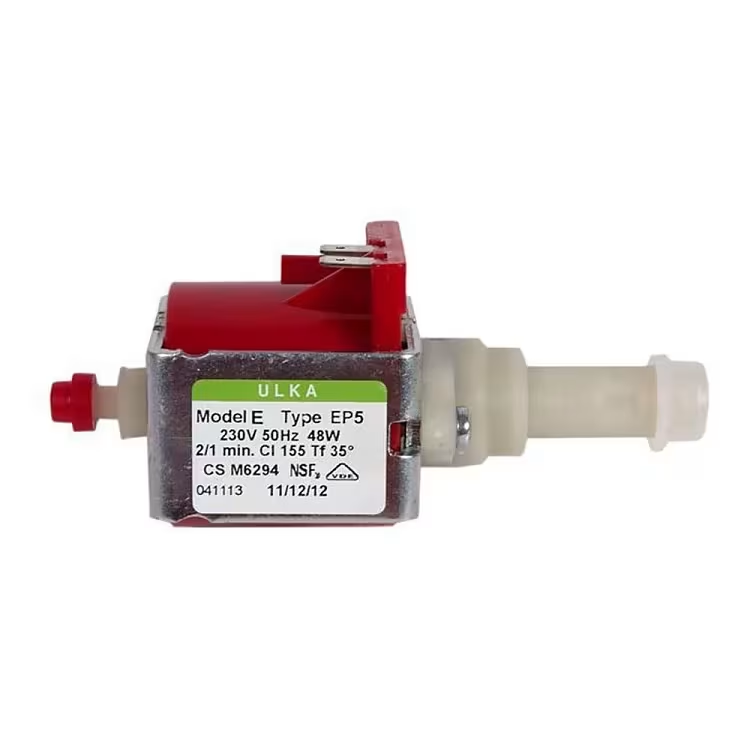
The role of the pressure pump in Nivona machines
The pressure pump is an essential part of every Nivona CafeRomatica automatic coffee machine. It builds the pressure required for proper extraction. On Nivona models that is typically 15 bar of pressure, of which the effective brewing pressure is about 9–10 bar. Without a working pump, the machine cannot push hot water through the compacted coffee puck in the brewing unit. The result is no coffee at all, or a drink with no taste or aroma.
Nivona CafeRomatica machines from the NICR 5xx series through the NICR 10xx series are fitted with vibration (oscillating) pumps from the Italian manufacturer ULKA — most often the EP5 (48W) and, on older series, the EP4 (48W). The pump uses an electromagnet that drives a piston at 50 Hz, producing a pulsating flow of water. The design is compact, the cost is low, and the pump is easy to replace. The membrane, though, has a limited service life and is easily damaged, especially if the machine runs without water.
Symptoms of a damaged pump in a Nivona CafeRomatica
A pump failure on a Nivona machine shows up in several ways. Reading the symptoms correctly makes the fault easier to identify:
- Loud buzzing with no coffee dispensed — the pump runs, but it does not build pressure. This is the most common sign of a worn membrane or a blocked check valve. The Nivona buzzes loudly, yet nothing comes from the spout, or only a very weak trickle.
- Weak, watery coffee — the pump does not reach the pressure needed for extraction. The coffee is pale, with no crema, and the brew takes longer. On Nivona NICR 7xx and NICR 8xx models this is especially obvious because of their demanding aroma profiles.
- The machine dispenses no coffee at all — the pump does not start, and there is no operating sound. This can mean a damaged electromagnet winding, a burnt-out coil, or a problem with pump power on the electronics board.
- Intermittent pump operation — the machine pours coffee unevenly, with pauses. This happens when the pump is partly scaled, or when the check valve is damaged.
- Water leaking around the pump — damaged seals or a cracked pump housing, usually caused by limescale and corrosion.
- Unusual noises — knocking, rattling, or a metallic crack during brewing point to a loose piston or mechanical damage inside the pump.
Causes of pump failure in Nivona machines
ULKA vibration pumps in Nivona machines have a finite service life. Several factors can wear them out sooner:
- Natural membrane wear — the piston membrane in an ULKA pump lasts on average 4–6 years with regular use (about 8,000–12,000 brew cycles). After that it loses elasticity and can no longer hold the required pressure.
- Internal limescale — scale settles on the check valves and inside the pump, reducing flow and increasing the load. The problem gets worse with hard water above 15°dH, especially when the machine is not descaled regularly.
- Running dry — starting the machine with an empty tank, or with the water path blocked, overheats the pump. Even a dozen seconds or so without water can permanently damage the ULKA membrane.
- Power surge — a sudden voltage spike on the mains can burn out the pump electromagnet coil. This is more common on Nivona machines that are plugged in without a surge-protected power strip.
- Corrosion and moisture — on older Nivona CafeRomatica machines (NICR 6xx series made before 2018), the pump electrical contacts sometimes corrode because steam condenses inside the housing.
ULKA vs Invensys — which pump does Nivona use?
Two manufacturers supply most vibration pumps for automatic coffee machines: Italian ULKA (CEME group) and British-French Invensys (now Fluid-o-Tech after the acquisition). Nivona fits only ULKA pumps in CafeRomatica machines, specifically:
- ULKA EP5 GW (48W, 15 bar) — on models NICR 520, 530, 620, 630, 646, 660, 680, 690, and 7xx
- ULKA EP4 GW (48W, 15 bar) — on older NICR 5xx models made up to 2016
- ULKA EP5 ST (48W, 15 bar, with a thermal sensor) — on premium models NICR 820, 825, 830, 842, 858, 960, 970, and 1030
Competing brands, mainly Jura and Krups, fit Invensys pumps (CP3, CP4). A Nivona needs an original ULKA pump with the correct fitting (threaded GW or push-fit). Invensys substitutes will not fit without modification.
Nivona models with the most common pump problems
A pump failure can affect any Nivona CafeRomatica model. From our workshop experience at AGD Group, a few are especially prone to it:
- NICR 520 / 530 — budget models, often used heavily in offices. The pump needs replacing on average every 3–4 years if you brew more than 10 coffees a day.
- NICR 660 / 680 — on these models the pump works harder because of the Double Cup function. The membrane wears out about 20% faster than on other models.
- NICR 820 / 825 — models with Aroma Balance need stable pressure. Even a small drop in pump output shows up immediately in the taste of the coffee.
- NICR 960 / 970 / 1030 — flagship models with the Spumatore system and a Flat White function. The pump serves both the coffee circuit and the milk circuit, so it does more work.
Checking a Nivona pump at home
Before you bring the machine to a workshop, you can check the pump at home:
- Sound test — start a brew and listen. A healthy ULKA pump makes a steady pulsing sound (about 50 pulses per second). Loud buzzing with no pulse, or a metallic crack, can mean the pump is damaged.
- Flow test — remove the brewing unit and switch on hot water (the Hot Water function). Water should flow evenly. If it only drips while the tank is fitted, the problem is the pump.
- Service-menu test — in the Nivona service menu (hold the right button for 5 seconds with the machine switched off, then switch it on) you can run the pump on its own. Check that pressure and flow are correct.
- Trial descale — if the pump buzzes but pumps weakly, try descaling with NIRK 703 tablets. Scale inside the pump sometimes mimics a failed pump.
How we repair a Nivona pump at AGD Group
At our workshop in Lodz, Nivona pump repair follows a set procedure:
- Initial diagnosis — we check pump pressure with a service pressure gauge (spec: 12–15 bar at the outlet), measure the coil power draw (spec: 48W ± 5%), and assess the seals.
- Removal and inspection — once the pump is out, we check the membrane, piston, check valves, and electromagnet coil. In 70% of cases the whole pump has to be replaced. In 30% of cases, a new membrane or an internal descale is enough.
- Replacement or reconditioning — we fit original ULKA EP5/EP4 pumps with full compatibility. After fitting, we calibrate the pressure and run a test of 10 brew cycles.
- Hydraulic circuit check — while replacing the pump, we also check the solenoid valve, the thermoblock, and every silicone hose for limescale and leaks.
Cost of a Nivona pump repair
Guide prices for pump repair on Nivona CafeRomatica machines at the AGD Group workshop:
- Diagnosis — 70 PLN (credited toward the repair)
- ULKA EP5/EP4 pump replacement — from 220 PLN (part and labor)
- Pump membrane replacement — from 140 PLN (when the housing and coil are still sound)
- Solenoid valve repair or replacement — from 160 PLN (often needed along with a pump failure)
- Internal pump descaling — from 90 PLN (ultrasonic cleaning of the valves)
A full hydraulic-circuit repair on a Nivona typically includes pump replacement, new seals, and thermoblock descaling.
Prevention — how to avoid a Nivona pump failure
Regular maintenance of a Nivona machine extends pump life considerably:
- Descale every 2–3 months — use original Nivona NIRK 703 tablets or NIRT 700 liquid. Regular descaling protects the pump from limescale and keeps the pressure stable.
- Claris water filter — fit a Nivona Claris filter in the water tank and replace it every 2 months. The filter lowers water hardness and reduces the chance of scale forming on pump parts.
- Never start the machine with an empty tank — running the pump dry is a common cause of membrane damage. A Nivona will show a no-water warning, but even a few seconds without water can already cause harm.
- Plug in through a surge protector — surge-protected power strips shield the pump electromagnet coil from voltage spikes on the mains.
- Annual service check — a professional inspection of the pump, seals, and thermoblock catches problems early and helps you avoid a costly breakdown.
Cennik i specyfikacja usług
Podstawowe parametry usługi
| Czas trwania | 3-7 dni w zależności od kolejki |
| Gwarancja | 3 Mies. |
Dodatkowe informacje
Wszystkie usługi serwisowe wykonywane są przez wykwalifikowanych techników z wieloletnim doświadczeniem.
Popularne usterki — naprawa w Łodzi
Najczęściej zgłaszane awarie ekspresów do kawy w serwisie AGD Group. Sprawdzenie od 70 PLN, naprawa zwykle 2–3 dni robocze.
Nivona service in Łódź
Nivona coffee machine repair at the independent after-warranty workshop AGD Group in Łódź. Genuine parts, diagnostics from €16, usually completed in 2–3 business days.
AGD Group is an independent after-warranty service — we are not an authorised manufacturer service centre.
- Address
- aleja Włókniarzy 234A, 90-556 Łódź
- Phone
- +48 459 568 444
- Hours
- Mon–Fri 9:00–19:00 (Sat–Sun closed)
- info@agdgroup.pl