


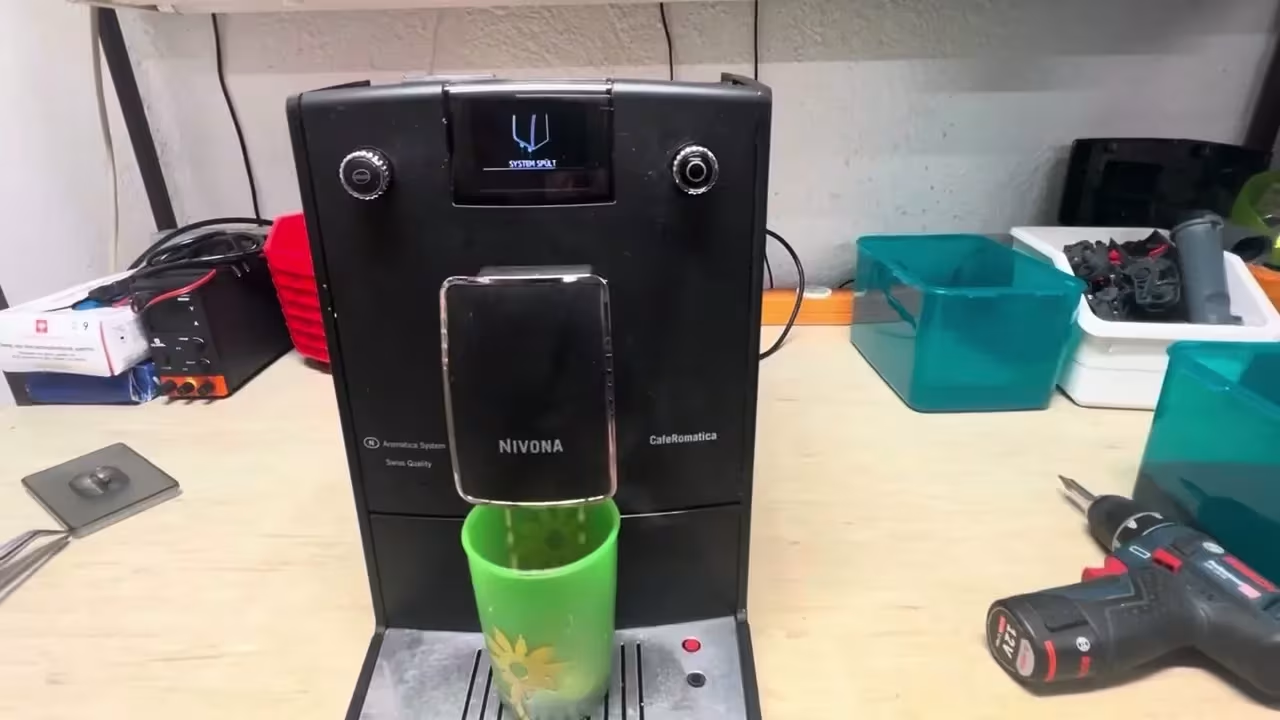
Water-intake faults are among the most common problems on Nivona CafeRomatica machines. They show up in several forms — from no water draw at all, through an intermittent flow, to an empty-tank message even though the reservoir is full. At AGD Group we repair these faults every day. We know the Nivona hydraulic system, and we know where to look for the cause.
Why is a Nivona machine not drawing water?
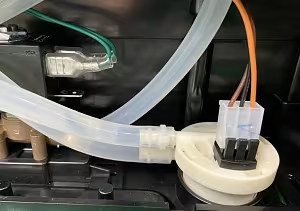
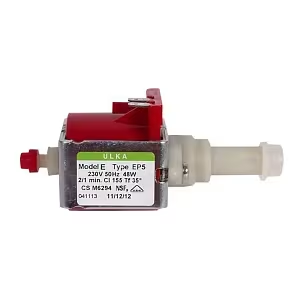
The hydraulic system in a Nivona CafeRomatica is made up of several key parts: a water tank with a level float, a flow meter, a solenoid valve, an ULKA pump (or a vibration pump on older models), and a heating thermoblock. A fault in any of these parts can stop the machine from drawing water.
Nivona uses a precise float sensor in the tank, and it is sensitive to limescale. Even a thin layer of scale on the float can jam its movement and trigger a false no-water signal.
Symptoms of a water problem on Nivona CafeRomatica
- “Fill the water tank” message — the tank is full, but the machine does not detect the water
- Brewing starts, then stops — the pump starts, but stops after a few seconds
- Weak coffee stream — water is flowing, but the pressure is too low for a proper extraction
- The machine ignores the brew command — the electronics block operation because there is no signal from the flow sensor
- Loud pump with no result — the pump is running dry, which points to a blocked path between the tank and the pump
- Intermittent flow — coffee comes out in bursts, which suggests a flow-meter fault or air in the system
Most common causes of water problems on Nivona machines
From our experience servicing Nivona machines, the most common causes are:
- A dirty or scaled tank float — the water-level float in a Nivona tank is a mechanical part. Scale, water deposits, or residue from a Claris filter can jam its movement. This is the most common cause, and the cheapest to repair.
- A faulty flow meter — a small sensor that measures how much water is passing through. Nivona uses turbine flow meters, which clog with scale over time, or whose impeller gets damaged.
- A failed solenoid valve — an electromagnetic valve that directs the water flow. It can stick in the closed position because of scale or mechanical wear.
- A scaled thermoblock — the Nivona heating thermoblock is compact and especially prone to scale buildup. As the channels narrow, water flow drops sharply.
- A worn pump — an ULKA pump loses output after 3–5 years of heavy use. The signs are a weak stream and noisier running.
- Air in the lines — after a long period out of use, or after the tank is replaced, air can block the hydraulic system.
Why is a Nivona machine not making coffee?
If a Nivona machine is not making coffee, the cause is usually in one of two areas: a water problem or a brewing-unit problem. No water intake stops the whole brew — the machine either shows an error message, or it tries to brew, but the pump cutting in and out will not allow a proper extraction. When the brewing unit is at fault, water does flow, but the mechanism does not form the coffee puck correctly. The result is watery coffee, or no coffee in the cup even though the cycle looks normal.
In both cases we recommend a professional diagnosis. Repair attempts without experience can make the fault worse, especially if you take a Nivona brewing unit apart. It has to be reassembled precisely.
What you can try yourself
Before you bring the machine to the workshop, check a few things:
- Bleed the system — take out the water tank, fill it to the top, fit it back, and run the rinse function 2–3 times. That clears air from the lines.
- Clean the tank and its socket — take the tank out and wash it in warm water with a little detergent. Check that the float in the tank moves freely. Clean deposits out of the tank socket in the machine.
- Replace the Claris filter — if you use a Nivona Claris water filter, check its expiry date. A spent filter can restrict the water flow. Also try running the machine without the filter.
- Run the descaling program — if the machine allows it, use a dedicated Nivona descaler or a general citric-acid descaler.
- Reset the machine — unplug it for 30 seconds, then plug it back in. Some sensor errors clear after a restart.
Nivona models most often affected by water problems
From our workshop statistics, water-intake problems most often affect:
- Nivona CafeRomatica 520 — an entry-level model with a smaller thermoblock, prone to scale buildup
- Nivona CafeRomatica 670 — a popular mid-range model, with frequent tank-float problems
- Nivona CafeRomatica 756 — a series with the Aroma Balance system; the flow meter is sometimes troublesome
- Nivona CafeRomatica 790 — one of the models we service most often, with complex hydraulic problems after 3+ years
- Nivona CafeRomatica 820 — a premium model, but the thermoblock scales just as readily as on less expensive models
Cost of repairing a Nivona water problem
| Service | Price from |
|---|---|
| Nivona machine diagnosis | 70 PLN |
| Tank float cleaning | from 80 PLN |
| Flow meter replacement | from 180 PLN |
| Solenoid valve replacement | from 200 PLN |
| Pump replacement | from 220 PLN |
| Thermoblock replacement or reconditioning | from 250 PLN |
| Full professional descaling | from 120 PLN |
The diagnosis fee (70 PLN) is included in the repair price if you go ahead with the work. The final price depends on the scope of the job and whether parts need replacing.
Prevention — how to avoid water problems
Most water problems on Nivona machines can be avoided with a few simple habits:
- Use a Claris filter — the dedicated Nivona Claris filter softens the water and reduces scale. Replace it every 2–3 months, or after it has filtered 50 liters of water.
- Descale regularly — even with a filter, descale the machine every 3–6 months. Nivona has a built-in descaling program — use it regularly.
- Clean the water tank — once a week, take the tank out, wash it with warm water, and dry it. Check that the float moves freely.
- Do not leave water standing for more than 2 days — standing water encourages bacteria and biofilm, which can clog parts of the hydraulic system.
- Use filtered or bottled water — if the water in your area is very hard (above 14°dH), consider filtering it through a filter jug before you fill the tank.
If your Nivona machine has a water problem, call us: 459 568 444 or visit the workshop in Lodz. Diagnosis usually takes 1–2 working days, and we complete most repairs in 3–7 days.
Cennik i specyfikacja usług
Podstawowe parametry usługi
| Czas trwania | 3-7 dni w zależności od kolejki |
| Gwarancja | 3 Mies. |
Dodatkowe informacje
Wszystkie usługi serwisowe wykonywane są przez wykwalifikowanych techników z wieloletnim doświadczeniem.
Popularne usterki — naprawa w Łodzi
Najczęściej zgłaszane awarie ekspresów do kawy w serwisie AGD Group. Sprawdzenie od 70 PLN, naprawa zwykle 2–3 dni robocze.
Nivona service in Łódź
Nivona coffee machine repair at the independent after-warranty workshop AGD Group in Łódź. Genuine parts, diagnostics from €16, usually completed in 2–3 business days.
AGD Group is an independent after-warranty service — we are not an authorised manufacturer service centre.
- Address
- aleja Włókniarzy 234A, 90-556 Łódź
- Phone
- +48 459 568 444
- Hours
- Mon–Fri 9:00–19:00 (Sat–Sun closed)
- info@agdgroup.pl