


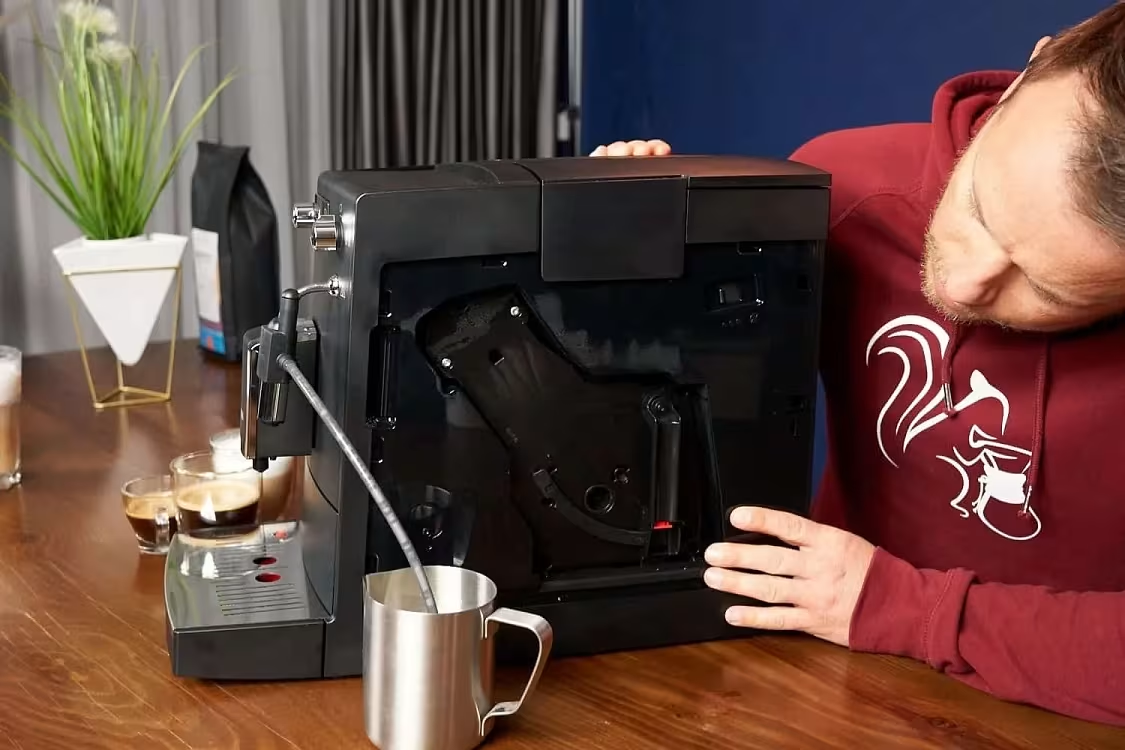
How to descale a Nivona coffee machine correctly
Descaling is one of the most important maintenance tasks for any espresso machine. On Nivona CafeRomatica machines the descaling procedure is built into the menu and runs semi-automatically. Here is the correct sequence:
- Preparation — empty the water tank and remove the Claris filter (if one is fitted). Dissolve a descaling tablet or liquid in the tank filled with water up to the MAX mark.
- Start the program — in the machine menu select: Maintenance → Descaling. Follow the instructions on the display.
- First phase — the machine pumps the descaling solution through the thermoblock and the hydraulic circuit. This takes about 15-20 minutes. Do not interrupt the process.
- Rinsing — after the chemical phase the machine asks you to empty the tank, fill it with clean water, and start the rinse cycle. Run 2-3 rinse cycles.
- Finishing — refit the Claris filter and fill the tank with fresh water. The first 2-3 coffees after descaling may taste slightly different — that is normal.
The whole process takes 30-45 minutes and should not be interrupted. Stopping descaling halfway can damage the thermoblock or lock the machine in a descaling loop.
Nivona will not finish descaling — causes
One of the most common problems reported by Nivona owners: the machine starts the descaling program but never finishes it — it returns to the start or shows a message that descaling must be run again. Causes of this behavior:
- Severe thermoblock blockage — the scale is so thick that one dose of descaler will not dissolve it. The treatment has to be repeated several times, or you need professional pressure descaling.
- Damaged flow sensor (flowmeter) — the machine measures how much water passes through the system. When scale blocks the sensor, it reads zero and treats descaling as failed.
- Blocked vent valve — air in the hydraulic circuit stops the descaling solution from flowing correctly.
- The wrong descaling agent — a solution that is too weak (for example diluted vinegar) does not dissolve scale well enough.
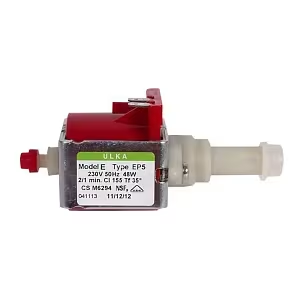
- Pump failure — the pump does not build enough pressure to push the solution through a blocked thermoblock.
If the machine does not finish descaling after two attempts with a suitable agent, a technician needs to see it. Further attempts can only make the situation worse.
What happens if you skip regular descaling
Limescale settles mainly in the thermoblock (the flow-through boiler) and in the hydraulic lines. Here is what can happen when descaling is neglected:
- Lower coffee temperature — scale acts as thermal insulation, so the machine struggles to heat the water to the right temperature (92-96°C).
- Slower brewing — narrowed lines restrict water flow and lengthen extraction, which spoils the taste of the coffee.
- A loud pump — the pump has to work at higher pressure to force water through blocked channels. That shortens its life.
- Thermoblock failure — in the worst case scale blocks the thermoblock completely and it has to be replaced (it is the most expensive part of the machine).
- Leaks — excess pressure from a blockage can damage seals and hydraulic connections.
- Descaling loop — the machine detects restricted flow, blocks normal operation, and forces a descaling cycle that never finishes.
Which descaler for a Nivona?
Nivona recommends its own NIRT 700 descaling tablets — tablets based on citric acid and sulfamic acid, made for CafeRomatica thermoblocks. Here is a comparison of the available options:
| Product | Effectiveness | Safety | Notes |
|---|---|---|---|
| Nivona NIRT 700 | Very high | Highest | Recommended by the manufacturer |
| Citric acid (food grade) | Medium | High | 25 g per liter of water; works more slowly |
| Durgol Swiss Espresso | Very high | High | Universal, more aggressive |
| Vinegar | Low | Low | Not recommended — leaves residue and an unpleasant smell |
| Supermarket "universal" tablets | Variable | Medium | Often too weak for espresso machines |
We recommend NIRT 700 or Durgol Swiss Espresso. Avoid vinegar — it is not strong enough for espresso machines, and the residue can corrode aluminum parts.
Nivona models that need descaling more often
How often you descale depends above all on the water hardness in your area, but some models collect scale more readily because of how they are built:
- Nivona CafeRomatica 520 / 530 — a smaller thermoblock that clogs sooner on hard water
- Nivona CafeRomatica 670 / 680 — popular models in heavy use; they need descaling every 2-3 months without a filter
- Models without a Claris filter — no filter can speed up scale build-up by as much as three times
- Office machines (many coffees a day) — descale every 4-6 weeks on hard water
A Nivona machine has a built-in counter and reminds you to descale on its own. Do not ignore that message — every day of delay raises the risk of permanent thermoblock damage.
Cost of professional descaling at AGD Group
When home descaling does not work, or the machine is stuck in a descaling loop, we offer a professional service:
| Service | Price from |
|---|---|
| Coffee machine diagnosis | 70 PLN |
| Professional descaling (agent + labor) | from 120 PLN |
| Pressure descaling (heavy scale) | from 180 PLN |
| Thermoblock replacement (when scale damage is irreversible) | from 350 PLN |
| Flow sensor replacement | from 150 PLN |
| Cleaning + descaling + full maintenance | from 200 PLN |
Diagnosis (70 PLN) is already included in the repair price. Call: 459 568 444.
How often should you descale a Nivona?
How often you descale depends on the conditions in which you use the machine:
- With a Claris filter + soft water (below 10°dH) — every 6-12 months
- With a Claris filter + hard water (above 15°dH) — every 3-4 months
- No filter + soft water — every 3 months
- No filter + hard water — every 4-6 weeks
- Office use (more than 10 coffees a day) — every 3-4 weeks without a filter, every 2 months with a filter
A Claris filter is worth using — it reduces scale build-up and improves the taste of the coffee. Replace it every 2-3 months or after about 50 liters of water.
Regular descaling is the cheapest form of maintenance. If you neglect it, the thermoblock can fail, and that repair costs far more than routine prevention.
Cennik i specyfikacja usług
Podstawowe parametry usługi
| Czas trwania | 3-7 dni w zależności od kolejki |
| Gwarancja | 3 Mies. |
Dodatkowe informacje
Wszystkie usługi serwisowe wykonywane są przez wykwalifikowanych techników z wieloletnim doświadczeniem.
Popularne usterki — naprawa w Łodzi
Najczęściej zgłaszane awarie ekspresów do kawy w serwisie AGD Group. Sprawdzenie od 70 PLN, naprawa zwykle 2–3 dni robocze.
Nivona service in Łódź
Nivona coffee machine repair at the independent after-warranty workshop AGD Group in Łódź. Genuine parts, diagnostics from €16, usually completed in 2–3 business days.
AGD Group is an independent after-warranty service — we are not an authorised manufacturer service centre.
- Address
- aleja Włókniarzy 234A, 90-556 Łódź
- Phone
- +48 459 568 444
- Hours
- Mon–Fri 9:00–19:00 (Sat–Sun closed)
- info@agdgroup.pl