Hundreds of coffee machines pass through our workshop each year. This honest 2025 report is based only on real repairs: repeated faults, weak designs, and which brands struggle most.
Why is our data on coffee-machine failure rates trustworthy?
Let's start with what matters in this kind of article: we have no advertising relationship with any coffee-machine manufacturer. We do not run paid campaigns, we do not write sponsored content, and we are not paid to praise one brand or to criticise another.
We use original parts when it pays off and they are available – that is usually simply safer and more reliable for the owner. But we are not any manufacturer's "extended arm". We answer for accurate diagnostics, an honest quote and the actual result of the repair, not for selling any brand.
That independence has a price. When we published repair statistics and practical comments on Krups machines, we received an official letter from the brand's Polish representative. It suggested that our content might "mislead" readers and "fail to give the full picture".
Our position – available here:
Why Krups is wrong – our position – makes it clear that:
- we do not present ourselves as an authorised manufacturer service centre,
- we do not suggest an official link with the Krups brand,
- we publish only our own service data and technical observations,
- the aim is to inform customers, not to attack any brand.
This article comes from exactly the same approach: we show the numbers, we show the design, and we show the practical consequences of manufacturers' decisions. No window dressing, and no exaggeration.
How was this report put together? What we actually analyse
Our analysis is not based on user surveys or on "impressions from everyday use". We rely on real repairs – on what lands on our service bench:
- the number of jobs for a given brand and model,
- the type of fault (mechanical, hydraulic, electronic, wear-related),
- whether the fault is a one-off or repeats across a production run,
- whether the failure comes mainly from user error or from a weak design,
- whether it can be repaired at component level, or whole modules have to be replaced,
- how the repair cost compares with the value of the machine,
- how the machine copes with real conditions – water, scale, and service that is not perfectly regular.
We therefore look at a machine from three angles at once:
- in use – what happens to it in a normal home or office,
- as engineering – how it is designed and where the weak points are,
- in the workshop – what a repair actually costs, how complicated it is, and whether it is worth doing at all.
Only when those three layers are put together can we fairly judge whether a given brand causes problems in everyday use.
Over the last two years we have analysed more than 12,000 repairs of machines from different brands. Every repair is documented, every fault is categorised, and the cost and the time are recorded. This is not data from a manufacturer's leaflet or from laboratory tests – it is the reality of Polish kitchens, offices and cafes.
Which coffee machines came in for repair most often in 2024–2025?
The table below shows the share of jobs by brand in our workshop over that period. These are our own observations, not official manufacturer figures and not a picture of the market as a whole:
|
No.
|
Machine brand
|
% of jobs in our workshop
|
|---|
|
1
| Delonghi | 27.59% |
|
2
|
Saeco
|
15.91%
|
|
3
| Krups | 15.16% |
|
4
|
Philips
|
13.67%
|
|
5
|
Siemens
|
8.70%
|
|
6
|
Nivona
|
6.21%
|
|
7
|
Jura
|
5.47%
|
|
8
|
Melitta
|
3.48%
|
|
9
|
Bosch
|
1.33%
|
|
10
|
Miele
|
0.83%
|
|
11
|
Gaggia
|
0.58%
|
The first reaction? Delonghi has the most jobs, so it must be the most failure-prone brand. That is a serious oversimplification, and in fact the wrong conclusion.
Why the job statistics are not the same as a brand's failure rate
These figures tell us one thing: which brands our customers buy most readily. Delonghi is one of the leading coffee-machine makers in Europe. That means there are simply more of these machines in homes, offices and cafes – which is why they come to us for repair most often.
The same goes for Philips/Saeco and Krups: these brands are on the shelves of practically every larger appliance store. The number of jobs tells us mainly about:
- how popular the brand is with customers,
- the scale of sales in our region,
- how many machines are out there.
To answer which machine fails most often, you have to look deeper than the percentage of jobs.
That is why the rest of this article does not look at how often a brand appears in the workshop. It looks at:
- which faults keep coming back,
- what the machine looks like inside,
- whether it can take scale, temperature changes and high pressure,
- whether a single part can be repaired, or the whole assembly has to be replaced,
- how the machine holds up after years of normal kitchen use, outside laboratory conditions.
From an engineering and service point of view,
Krups machines come out worst in 2025.
Why Krups is number one in our 2025 anti-ranking
Let's be clear from the start: Krups is not a "bad machine by definition". The brand has a few interesting design solutions, and some owners use the machine without trouble through the first years. It still has to be said plainly that:
- Krups designs are too delicate and too sensitive to normal home conditions,
- they have a very small margin of tolerance for scale, dirt and user mistakes,
- the manufacturer's service policy favours replacing modules instead of repairing parts, which pushes the cost up and shortens the life of the machine.
An engineer's view, and an SCA judge's
As an engineer and a certified Specialty Coffee Association (SCA) judge, I do not look at a machine only as a "box that makes coffee". I look at it as a specific set of hydraulic, thermal and mechanical solutions.
From that point of view it is clear that a Krups:
- was designed for almost ideal conditions (stable water, regular servicing, no overload),
- copes very badly with anything that steps outside those ideal conditions – in other words, ordinary home life.
In practice that means a machine which works flawlessly in the showroom starts to have problems after two or three years in a typical Polish kitchen. On other brands those problems show up much later, if they show up at all.
Water and Krups – the design, not the user
A lot of myths have grown up around water. It is true that every coffee machine suffers from scale if it is not descaled properly. The difference is that some brands have a sensible design margin for the occasional lapse, and others definitely do not.
With Krups we see the following:
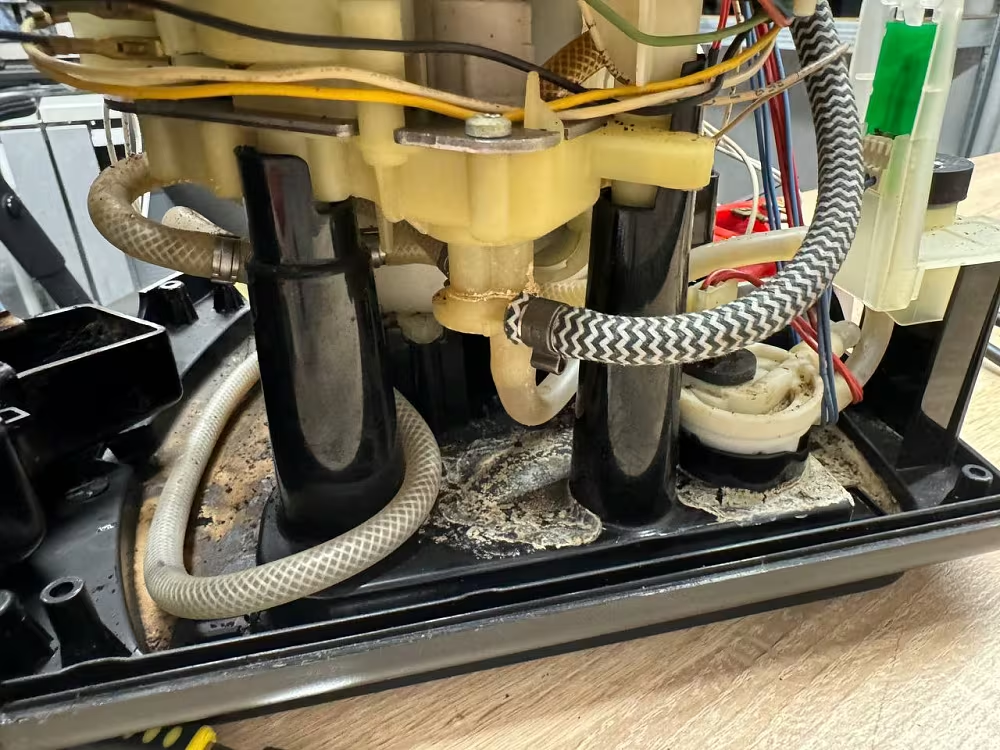
- the water circuit has unusually narrow channels and critical spots where deposits quickly restrict the flow,
- small amounts of scale that other machines still tolerate already cause errors and leaks on a Krups,
- some materials – plastics, seals, connectors – lose their properties faster in contact with deposits and temperature changes.
That comes down to one simple fact: Krups is very poor at forgiving typical tap water and ordinary user habits. Where a Delonghi or a Philips will still keep going for a while, a Krups ends up in the workshop.
A typical story looks like this. The owner uses the machine for a year or two and descales only now and then (because it still works). Then an error appears, or a leak, or the machine stops making coffee. Cause: scale in a critical part of the water circuit. Repair: a module replacement, often costing more than half the value of the machine.
Hydraulics instead of mechanics – pros and cons of the Krups design
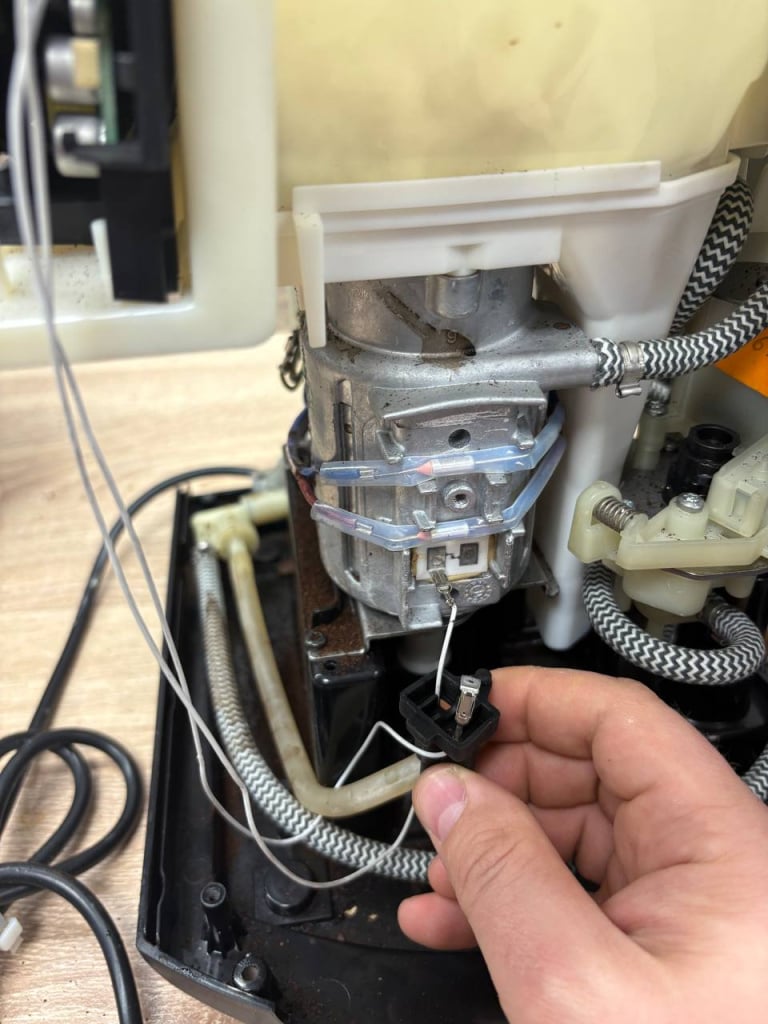
Krups stands out because it relies mainly on hydraulics, not on mechanics. Brewing is done by pressurised water that compresses the coffee puck directly in the boiler. That solution has its advantages and its drawbacks:
Advantages of the hydraulic design:
- Brewing directly in the boiler – the coffee is prepared in the same vessel where the water is heated, which gives high thermal stability,
- no complex mechanisms that transfer motion and can wear out,
- a simpler drive concept – the water does most of the work.
Drawbacks and problems:
- Many seals and hydraulic parts – the system needs numerous gaskets, valves, connectors and hoses that have to withstand pressure and temperature,
- every seal is a potential leak point, especially after several years of use,
- Heavier build-up of coffee-oil deposits – brewing happens directly in the boiler, so coffee oils settle in the hydraulic circuit and form a deposit that is hard to remove and, over time, starts to block channels and valves,
- together with scale, those deposits form a mix that is particularly hard on the narrow hydraulic channels in a Krups,
- fixing a leak often means replacing whole hydraulic modules, not individual parts.
In practice that means the Krups hydraulic design, elegant in theory, needs very regular servicing and cleaning. Where a machine with traditional mechanics can still run with light contamination, a Krups already has trouble with water flow and pressure.
What makes this especially difficult is that coffee-oil deposits combined with scale form a hard layer that is hard to remove and blocks the narrow channels. Standard cleaning programmes cannot deal with it, and cleaning by hand means a strip-down that is complicated on a Krups.
A tight internal layout – a technician's nightmare
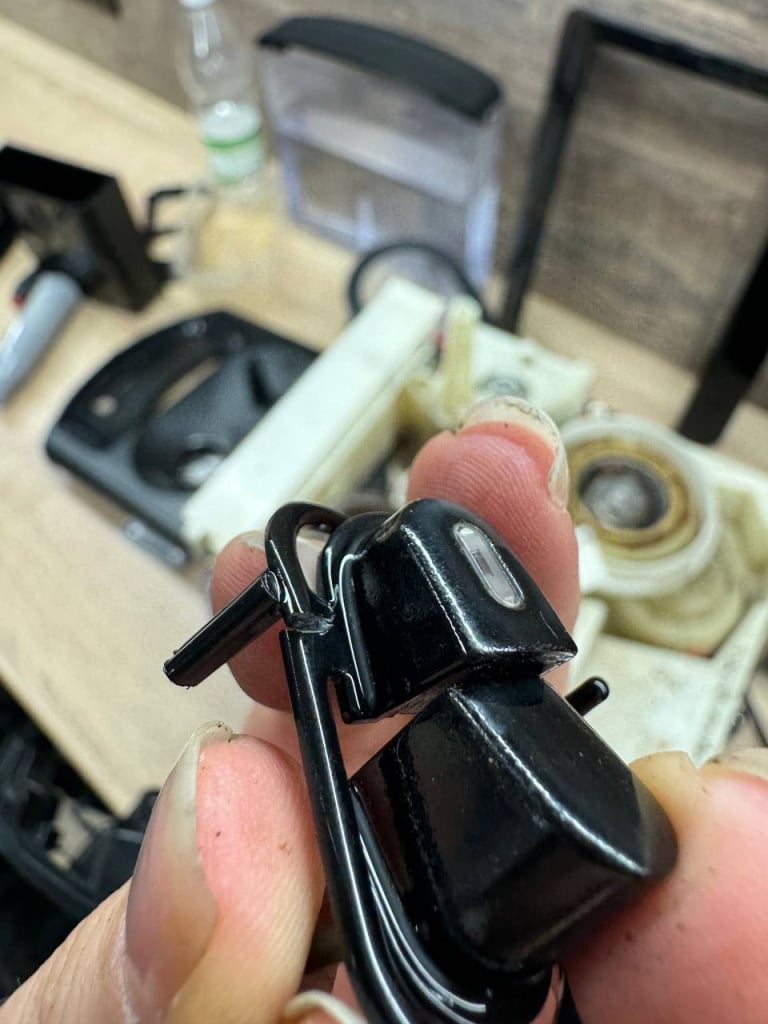
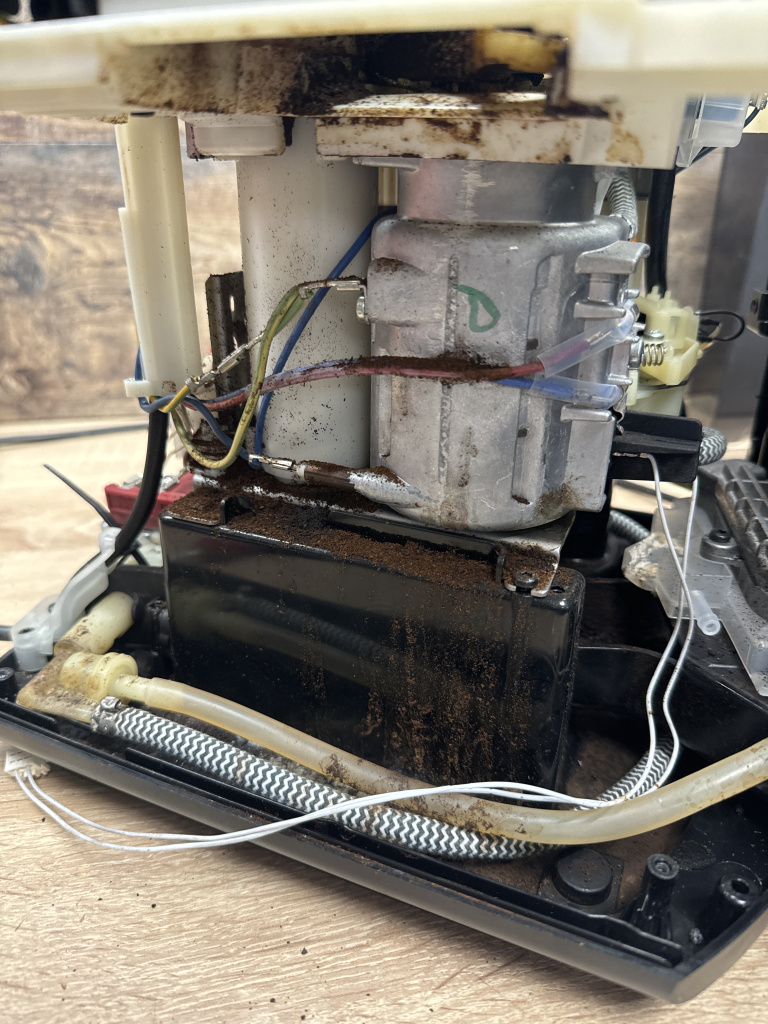
From the outside a Krups can look neat and compact. Take the housing off, though, and the inside is packed very tightly:
- reaching many parts means stripping half the machine,
- accidentally damaging a neighbouring part during a repair is a real risk,
- even routine service work takes longer than on competing machines.
That is why not every workshop is willing to take on a Krups repair. And when one does, a lack of experience with this particular design can end in secondary damage.
In our workshop we have seen cases where an attempt to repair one part ended with several others having to be replaced. Getting at the failed part meant removing neighbouring modules, and those modules were damaged in the process.
Service policy: replace the module instead of repairing the part
Krups's service policy is a separate issue. In many cases the official guidance for authorised centres is:
- replace whole modules (for example the entire brew unit) instead of repairing a single part,
- no support for component-level repairs, even when they would be technically possible,
- simple diagnostic paths that lead to one conclusion: "replace the module = the only recommended solution".
For the owner that means:
- high repair costs for relatively minor damage,
- frequent decisions that a repair is "not worth it",
- a shorter real life for the machine than the idea of the design itself would suggest.
A practical example: a leaking seal in a hydraulic module. On other machines you replace the seal itself for around €10–20. On Krups the official service path is to replace the whole module for around €70–160. On a machine worth €186–233, that often decides that the repair is no longer worth doing.
Secondary damage after failed repairs
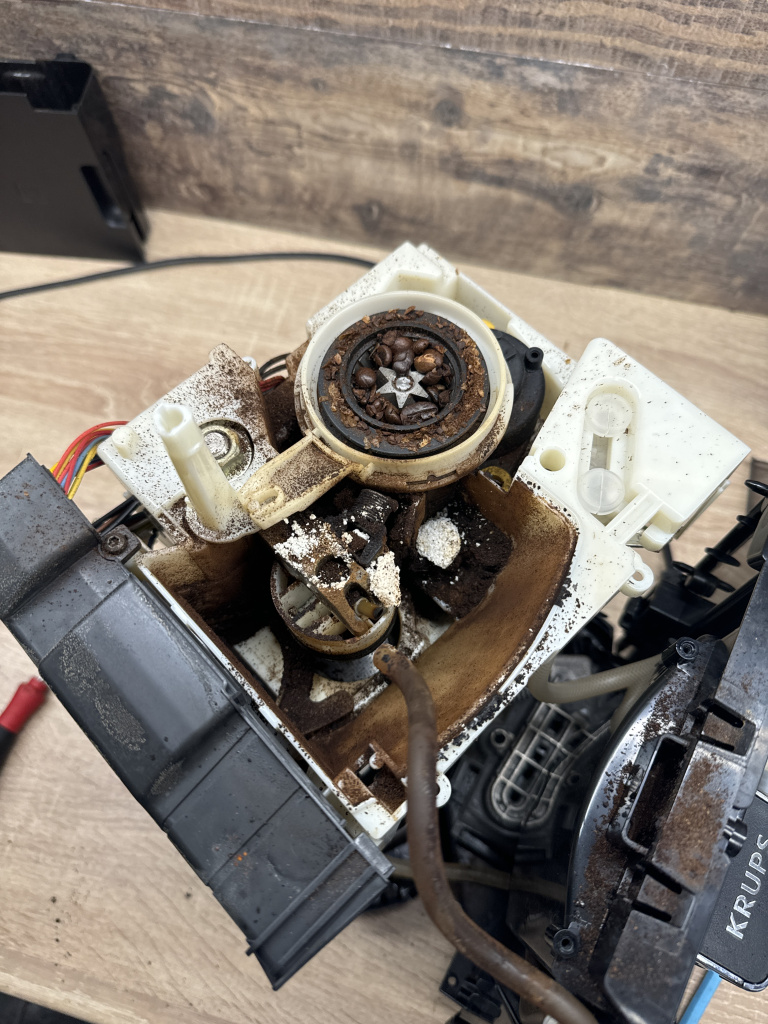
Our repair figures show another effect as well: many Krups machines reach us as a "second attempt" after an unsuccessful repair in another workshop.
Typical problems after that kind of "servicing" are:
- brew units assembled incorrectly,
- seals that are damaged or poorly seated,
- cracked clips and handles,
- drive positions set incorrectly,
- wires that are pinched or routed the wrong way.
That further increases the number of Krups jobs in the statistics and, at the same time, shows that this brand really does demand a high standard of service work. Where that standard is missing, the machine suffers twice.
In our workshop we have specific procedures for Krups machines that come in after a failed repair. It often turns out that the original fault was fairly minor, but the way it was repaired created extra problems. Those now need a much more involved repair.
No real evolution in the design
From an engineer's point of view, the most disappointing thing is that many weak design choices in Krups machines have been repeated for years. What changes is:
- the look of the front panel,
- the colours and the series names,
- design details and marketing features.
Inside, we still see:
- the same critical spots in the water circuit,
- the same types of valves and connectors that collect deposits,
- the same hydraulic parts working at the limit of their strength.
In other words: the problem is not new, but it still has not been solved at the design level.
Comparing Krups models from different years, we see the manufacturer making cosmetic changes and leaving the fundamental design problems in place. That suggests either that those problems are not recognised (which seems unlikely) or that the business priorities are something other than long-term reliability.
What about the other brands? A short comment on the statistics
The article focuses mainly on Krups, but the other manufacturers are worth a mention too:
- Delonghi – it has the most jobs, but also one of the largest installed bases on the market. Many repairs are relatively simple and worth doing, and the machines cope well in typical home conditions. Most often you replace seals or repair the grinder, which usually does not mean changing whole modules.
- Philips / Saeco – solid construction and a balanced price-to-quality ratio. You can see the design evolving, and a real effort to correct earlier mistakes. The cleaning systems are well designed, and access to service parts is better than on Krups.
- Siemens, Bosch – a higher price bracket and more complex electronics, but also a higher standard of design. Faults do happen, yet the machines have more tolerance for real operating conditions. Repairs can be carried out at the level of individual components.
- Jura, Nivona, Melitta – these brands have problems too, but many models show a strong focus on material quality and on reliable water circuits. The machines are designed with long-term use in mind.
This is not a full analysis – each brand could have an article of its own. We only want to set the context: Krups's problems are not a trouble shared by every manufacturer. Against the competition, this brand copes clearly worse when it comes to tolerance of real conditions of use.
Summary – why Krups tops our 2025 anti-ranking
Reduced to the point:
- statistically it is not the brand with the most jobs – Delonghi has a larger share,
- but the nature of the faults, the cost of repairs and how hard the machines are to service mean that, in practice, Krups is the most problematic brand in our workshop in 2025,
- Krups machines are designed with a low tolerance for scale, deposits and user error,
- the service policy promotes module replacement instead of part repair, which means high costs,
- many weak points in the design are repeated in later generations of the machines,
- the design tries to combine compactness with performance, but it lacks durability over a longer period.
We are not out to "attack" the Krups brand. We want to point out a real problem that shows up every day on the service bench. An owner should know the consequences of choosing a particular design – not only at the moment of purchase, but above all after several years of use.
As an independent workshop, and speaking as an engineer and an SCA judge, we would rather tell the truth about the equipment we work on than pretend that every coffee machine runs perfectly if you just run the cleaning programme regularly. Reality is more complicated, and it is our job to describe it clearly and honestly.
If you have a Krups machine and are thinking about a repair, get in touch. We know this brand and we know how to deal with its particular problems. If you are only planning a purchase, we hope this article helps you decide with both eyes open, knowing the strengths and the weaknesses of different designs.