


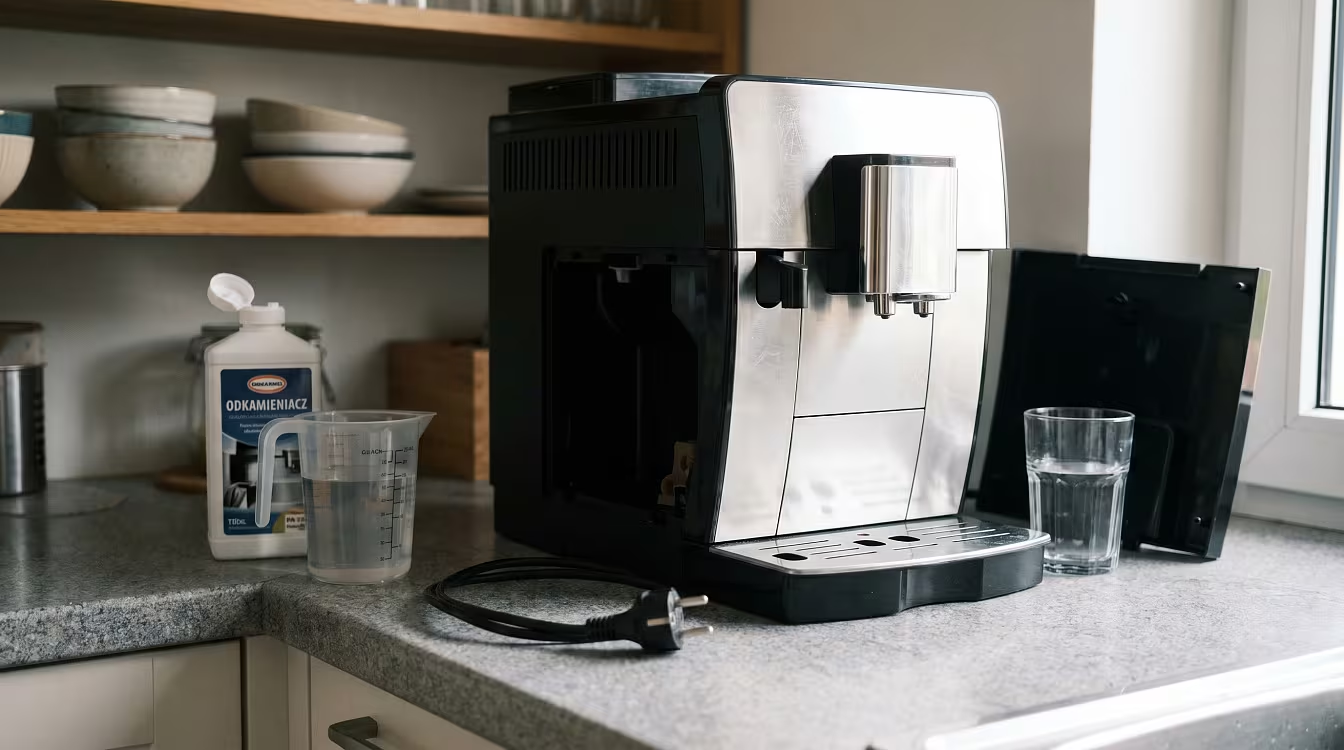
After a move, the machine brews the first espresso and then, exactly halfway through the cycle, the display goes dark. There is a short click, and the cup is left with coffee that never finished brewing. Or another scenario: in the morning you switch the machine on, it starts grinding the beans, and a few seconds later everything goes quiet.
Why does a coffee machine keep switching itself off? It usually does not do this for no reason. The machine cuts the power when something in the system goes outside the normal range: the temperature rises too fast, the water flow is blocked, moisture has reached the electronics, or the brew programme stops at one of its stages.
What follows is not another code table for every brand, but a map of six shut-off moments from AGD Group workshop practice: what is behind each scenario, what you can check yourself without procedures copied from other platforms, and when switching the machine on again does more harm than good.
6 situations in which a coffee machine switches itself off — a quick symptom map
Based on customer reports, we put together a simple breakdown. The same symptom — "the coffee machine switches itself off" — can mean something different in the workshop depending on when the machine stops:
- right after start — the display flashes and goes dark: a possible power problem, moisture at the switch, a faulty start sensor, or a valve that does not close the water circuit
- during brewing or frothing — the pump does not hold pressure, the ceramic valve does not move on to the next phase, the thermal protection reacts to overheating,
- after a few minutes of inactivity — a programmed auto-off (normal), or unstable electronics that lose the ready state,
- at random, with no pattern — we most often check loose internal connectors and traces of moisture at the control board after a long-running leak,
- only with one drink (for example cappuccino, not espresso) — the milk system or the valve sequence, not the whole machine,
- after a longer break in use — scale in the boiler, standing water, mould in the lines — the system starts against resistance and the electronics interrupt the cycle.
Before you look for a reset online, note which of the points above fits. That shortens diagnosis more than the model number alone.
Right after "Good morning" — power, moisture and the first valve
When the machine goes dark in the first few seconds, service notes and customer reports most often point to three groups of causes.
The power supply. A damaged plug, a frayed cable, a weak socket or an overloaded power strip can cut the current at the moment the pump and the heater draw peak power. In a new flat — after a move — it is worth trying another socket without an extension lead before you suspect the machine's electronics.
Moisture around the housing. A leak from the drip tray that runs under the body is often mistaken for a board failure. Water at the switch or the power connectors is a direct path to a sudden shutdown — a sensor or a thermal fuse opens the circuit to protect the rest of the system.
Mechanics at start-up. On automatics with a ceramic valve, a delay on the first water cycle can be normal — but when the valve does not close properly, the machine interrupts the process and switches off instead of brewing. This is one of the threads on the service forum for models that switch off immediately after being turned on: the problem appears right after start, not only with the second coffee.
If, after drying around the machine and changing the socket, the problem returns in exactly the same way, home checks have reached their limit and workshop diagnostics are needed.
Halfway through the brew — when the machine loses pressure or breaks the cycle
A shutdown during operation is the scenario that causes the most concern: the machine is working, grinding beans, heating water — and then everything goes quiet. In workshop practice these symptoms often go together with problems of water flow, temperature, scale, a leak, or worn internal parts. Before you check any component, unplug the machine.
Signs of a weakening pump — weaker-tasting coffee, slower flow, and little or no steam when frothing milk — can come before a sudden shutdown halfway through the cycle. The pump does not hold the correct pressure, the brew leaves the normal range, and the electronics stop the machine.
The second common cause is overheating. Scale on the heater or in the boiler makes it harder for heat to transfer properly, so the system can heat differently from what the programme expects. The machine then protects itself and cuts operation. That is why the problem often returns when descaling has been neglected: if the alerts were ignored for weeks, a rinse on its own is usually not enough. More on what neglect leads to is in the article 7 mistakes that shorten the life of a coffee machine and in the descaling guide.
With regular maintenance a coffee machine can last 5–10 years — lifespan depends on the manufacturer, the class of the machine, and above all the water. When a machine that is several years old switches off halfway through a brew after a long time without maintenance, it is usually not one simple fault. In the workshop we most often see several problems at once: deposits, worn seals, and a pump working under a heavier load.
Philips and Saeco — Error 04, the brew unit and an interrupted brew cycle
In Philips and Saeco technical documentation, Error 04 means the brew unit is fitted incorrectly. This is not an abstract message — with a badly seated brew unit the machine can start the cycle, then interrupt it and switch off, because the brew unit drive does not complete the circuit.
A typical workshop scenario: the customer took the unit out to rinse it, fitted it by eye, and after the start message the machine switches off or knocks with a metallic sound. Before you suspect the electronics:
- take the brew unit out and check that there are no dried grounds on the guides,
- fit it until you hear a clear click — without forcing it,
- run one rinse cycle without coffee and watch whether the cycle runs to the end.
If Error 04 returns despite correct fitting, the cause is often a worn drive, the seals, or deposits between the segments of the unit — that is a mechanical repair, not a menu reset. Service details for these brands: Philips and Saeco at AGD Group.
De'Longhi — when the electronics switch the machine off during operation
Answering the question why a De'Longhi coffee machine switches itself off: switching off during operation is a serious fault that usually means an electronics fault — the machine is protecting itself against unexpected situations such as overheating, or a process that does not follow the correct sequence.
In De'Longhi workshop practice we often see this after:
- long-neglected descaling — scale raises the temperature and interrupts the sequence,
- a leak that left the control board damp — the shutdown can be random, not only with one drink,
- a faulty temperature sensor — the machine heats more slowly or too quickly and interrupts the cycle halfway,
- a seizure in the brew system — the electronics do not receive confirmation that a phase has finished, and they cut the power.
Do not copy reset procedures from other brands — the De'Longhi platform has its own menu logic. If the machine switches off for the second time in a row, do not force another cycle. Book an inspection: De'Longhi coffee machine service.
Krups, Siemens and automatics with a ceramic valve — the same symptom, different mechanics
With automatic Krups machines we often hear a similar description: the machine starts, something works inside for a moment, and then it switches off before it has time to make the coffee. Similar reports also come in for Siemens EQ machines, when the machine switches off already during start-up. There are several possible causes: moisture at the switch, a faulty heater sensor, a problem with the pump, the drive, the ceramic valve, or the electronics. This cannot be assessed reliably over the phone — it needs diagnostics after the machine has been opened.
What these cases share with De'Longhi and Philips:
- the shutdown happens when the machine cannot complete the sequence — not because it refuses to brew,
- earlier symptoms can be subtle: longer heating, thinner crema, a single click from the valve,
- switching the machine on again and again after it has gone dark worsens the brew unit drive or the control board.
For Krups and Siemens we do not quote universal codes taken from other platforms — the same Error number on another brand can mean something entirely different. When you contact us, give the full model from the rating plate. Service: Krups · Siemens.
What you can safely check yourself — without guessing and without taking the machine apart
Before you bring the machine to the workshop in Lodz, you can take a few steps that do not need service tools and do not void the warranty under normal use:
- Another socket, without a power strip — rule out a problem with the electrical installation in a new flat.
- Dry the worktop and the base of the machine — moisture under the housing is a common cause of a sudden cut-out.
- Brew unit — take it out, rinse it, and fit it fully home (especially Philips/Saeco and many automatics with a removable brew unit).
- Water tank and filter — an empty or badly seated tank can interrupt start-up; with hard water, check whether the filter is worn out.
- One calm rinse cycle — if the machine switches off halfway, do not start it five times in a row.
What we do not do at home without diagnostics: opening the housing, replacing fuses blind, and resets copied from another brand's manual. Typical coffee machine repairs cover leaks, weak brewing, blocked brew heads and flow problems — regular rinsing and descaling extend the life of the machine, but they will not replace a pump or electronics repair once the machine already switches off on every cycle. A broader look at faults: what most often fails in coffee machines.
How much it costs to repair a coffee machine that switches itself off — the AGD Group price list
Every job starts with a check of the machine — €16 (free if you go ahead with a repair). We do not tie the moment of shutdown to a fixed figure — the quote comes after inspection. From the coffee machine service price list, as a guide:
- full coffee-circuit cleaning — from €19,
- full milk-circuit cleaning — from €21,
- seal replacement — from €23,
- pump replacement — from €23,
- heater replacement — from €23,
- descaling with chemical and mechanical cleaning — from €35,
- brew unit reconditioning — from €35,
- milk system repair — from €35,
- machine repair without descaling — from €47,
- machine repair with a full descale — from €58.
When a machine switches off halfway through a brew after years without maintenance, the job often comes out as a package: descaling plus a mechanical repair — which is why the item that includes descaling is higher. We describe the wider price context in the guide to coffee machine repair costs. Before a longer break in use it is also worth looking at the 2026 pre-holiday coffee machine checklist — standing water in the boiler can turn a small fault into a sudden shutdown after you get back.
Book diagnostics in Lodz — before the next start damages the machine
Why does a coffee machine keep switching itself off? Because the machine cuts the power when something in the water, thermal or electronic system goes outside the safe range — from a loose socket and a badly fitted brew unit (Error 04 on Philips/Saeco) to an overheated boiler, a ceramic valve and the protective electronics on a De'Longhi. The more precisely you describe when the machine goes dark, the faster we can separate a simple cause from a repair that needs parts.
Bring the machine to AGD Group in Lodz, or call — give the model, the moment it switches off, and whether the problem appeared suddenly after a move, a holiday, or a long period of ignoring descaling. The check is €16, and repairs are covered by the workshop warranty.
Call: +48 459 568 444 · Book a visit online